Waterfall Enrichment: The 2026 Playbook for Maximum Lead Coverage

One data provider will never cover your whole list. Stacking several in the right order will.
Every outbound team eventually runs into the same wall. The target account list is right, the messaging is sharp, and then a third of the contacts turn out to have no working email or phone number attached to them.
Waterfall enrichment is the fix most high-performing revenue teams have already adopted. Instead of betting on one vendor, you route each contact through several in sequence, and each tier picks up what the one before it missed.
Here is how the approach works, what a 2026 provider stack looks like, what it costs, and where teams get it wrong.
The Cold Reality of B2B Prospecting in 2026
You have built the perfect target account list. Your ICP is dialed in. Your messaging is sharp.
Then you hit the data wall:
- 40% of your leads have no contact information
- 25% of emails bounce
- 60% of direct dials go to dead numbers
This is more than a daily annoyance. It costs an estimated 28% of potential revenue (Gartner 2024), and the damage compounds. High bounce rates drag down sender reputation, which quietly reduces inbox placement for the contacts that were valid.
The good news is that the fix is well understood and already running inside most top-performing revenue teams. Here is what the rest of this playbook covers:
- 1How waterfall enrichment actually works
- 2Why it became mandatory, not optional
- 3The 2026 waterfall stack and what it costs
- 4Four benefits that show up in pipeline
- 5Build vs. buy, and when each makes sense
- 6A four-step implementation blueprint
How Waterfall Enrichment Actually Works
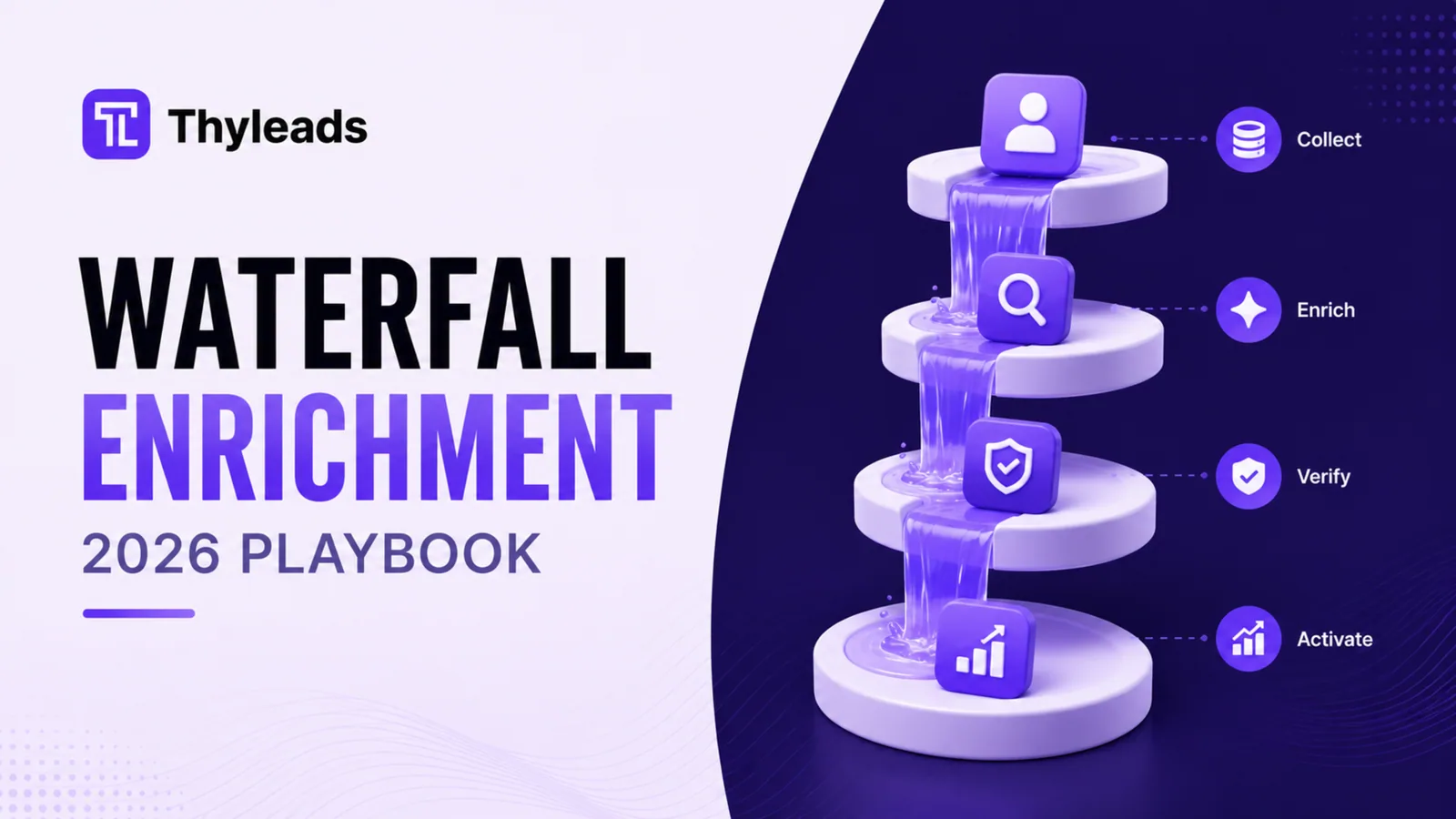
A waterfall runs your contact list through providers in sequence. Each tier catches what the one before it missed:
- 1Primary vendor: covers about 60% of your list
- 2Secondary vendor: adds another 25%
- 3Tertiary vendor: adds a further 10%
- 4Niche provider: catches the final 5%
End result: 95%+ contactability versus roughly 60% with a single provider. When one vendor comes up empty, the record falls through to the next, and so on, until you have a usable contact.
The mechanic that matters is conditional spend. You only pay the next provider for the records the previous one failed to resolve, so cost scales with the gap rather than with list size. That is what separates a waterfall from simply buying four databases and merging the exports.
Where teams misread the numbers
Coverage and accuracy are not the same thing. A provider can return an email for 90% of your list and still be wrong a fifth of the time. Track verified contactability, not raw match rate, and put a verification step at the end of the waterfall before anything reaches a sequence.
Why Waterfall Enrichment Became Mandatory
Three shifts turned this from a nice-to-have into table stakes.
Vendor specialization keeps narrowing
No database wins everywhere anymore. Coverage now splits along geography and segment lines:
- Apollo is strongest across US tech
- Lusha performs best on global mid-market
- ContactOut leads on APAC executives
If your ICP crosses regions or company sizes, a single provider guarantees blind spots.
Data decay keeps speeding up
Roughly 45% of contacts change every year (ZoomInfo 2024). A list enriched once and left alone is materially worse six months later, which is why re-enrichment belongs on a schedule rather than in someone's backlog.
The competitive gap is measurable
Teams running waterfall enrichment outsell single-source teams by roughly 3:1 (RevenueBase). Part of that is volume, and part of it is access: a meaningful share of contacts only exist in one vendor's database, so your competitors working off a single tool never see them.
The 2026 Waterfall Stack and What It Costs
A working stack usually looks something like this, ordered cheapest and broadest first:
| Tier | Provider | Specialization | Avg. Cost/Contact |
|---|---|---|---|
| 1 | Apollo | US Enterprise | $0.18 |
| 2 | Lusha | Global Mid-Market | $0.22 |
| 3 | ContactOut | APAC/EMEA | $0.25 |
| 4 | Datagma | French Market | $0.30 |
| 5 | Swordfish | Direct Dials | $0.35 |
Costs are indicative and move with contract volume, so treat the ordering as the point rather than the exact figures. Sequence matters more than the individual prices: putting your most expensive provider first means paying premium rates for records a cheaper vendor would have resolved anyway.
Pro tip: layer in technographic (HG Insights) and intent (Bombora) waterfalls for account-based plays. The same conditional-spend logic applies, and the signals stack on top of contact data rather than replacing it.
4 Benefits That Show Up in Pipeline
Running a waterfall instead of a single provider changes four things that show up directly in pipeline:
- 3x more conversations. You reach 95% of your target account list instead of 35%.
- Competitor-free prospects. 22% of contacts are vendor-exclusive, so you find people your competitors cannot (FullEnrich 2024).
- Full market coverage. Geo and vertical gaps get filled automatically as each tier picks up what the last one missed.
- Future-proof scaling. New providers plug into the same workflow, so coverage improves without a rebuild.
The one thing a waterfall does not fix is targeting. Better coverage on a poorly defined ICP just means reaching more of the wrong people, faster.
Build vs. Buy: Which Waterfall Setup Fits Your Team
You can wire up a waterfall yourself, and for a two-provider setup on a narrow ICP that is often the right call. The maintenance cost is what turns it into a bad trade at scale.
Where DIY breaks down
- Time sink. Maintaining the APIs eats 150+ hours a year as endpoints, rate limits, and response formats change.
- Coverage gap. A hand-built stack realistically tops out at three or four providers before the routing logic becomes its own project.
- Contract overhead. Every provider added means another minimum commitment, another invoice, and another set of credits that expire unused.
Tools that do it for you
- FullEnrich: 17 providers with automatic optimization.
- Clay: smart routing based on lead attributes.
- Clearbit: a built-in waterfall for enterprise teams.
The honest trade-off is control. Managed waterfalls hide the routing logic, so you get coverage without visibility into which provider resolved what. If provider-level attribution matters to your team, ask for it before you sign.
Implementation Blueprint: Four Steps to a Working Waterfall
Four steps to get a waterfall running:
- 1Audit your current coverage gaps
- 2Stack vendors by geo and vertical strength
- 3Set a maximum cost threshold per tier
- 4Automate re-enrichment every 90 days
Pro tip: try reverse waterfalling. Check niche providers first for the hidden gems the big databases miss. It costs more per record, so run it on a priority segment rather than the full list.
Three things to get right before you scale it
- Deduplicate before enriching. Paying five providers to resolve the same duplicate record is the most common way waterfall budgets quietly overrun.
- Verify at the end, not the start. A final verification pass on the merged output is what keeps bounce rates under 5% and protects sender reputation.
- Check the compliance posture of every tier. GDPR and regional data rules apply to the niche providers at the bottom of your stack exactly as much as to the household names at the top.
Should You Run a Waterfall in 2026?
If your ICP sits in one region and one segment, a single strong provider may still cover you. For everyone else, the answer is yes, and the only real question is whether you build it or buy it.
Start small. Add one secondary provider behind your current one, measure the lift in verified contactability, and let that number decide whether a third tier earns its place. Teams that try to stand up five providers at once usually end up with cost they cannot attribute and coverage they cannot explain.
The teams winning in 2026 are not picking one data provider over another. They use several, in a deliberate order, with verification at the end and re-enrichment on a schedule.
Want a waterfall running without building it yourself? Thyleads operates a multi-source enrichment engine that verifies 100,000+ emails a month for B2B SaaS clients.
About Thyleads
Thyleads is a B2B lead generation company that helps SaaS companies find and convert high-intent prospects using signal intelligence and AI-powered automation. Our clients typically see 3x higher response rates and 40% shorter sales cycles within 90 days of getting started.