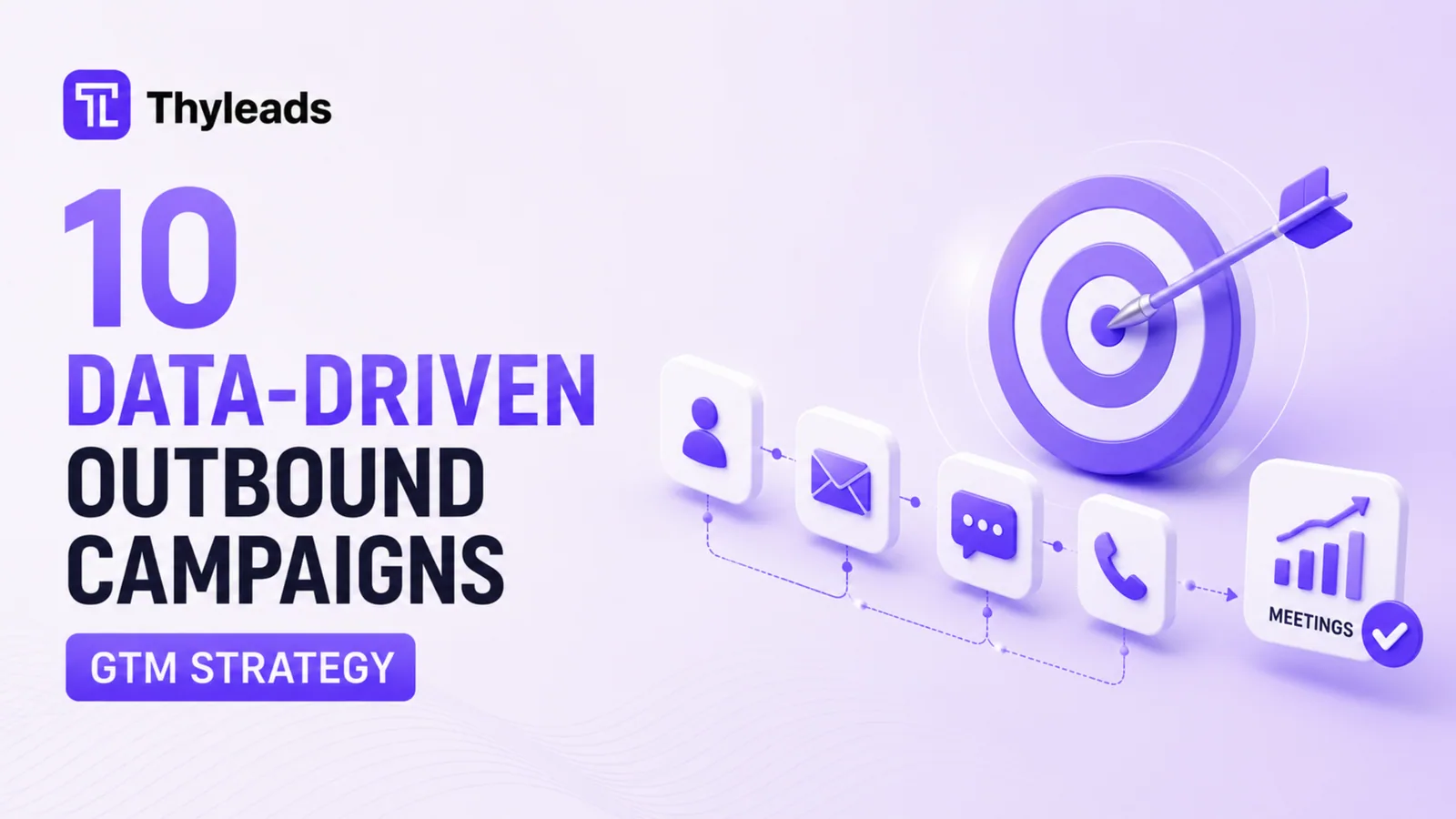
10 Data-Driven Outbound Campaigns to Sharpen Your GTM Strategy

Generic outreach stopped converting a long time ago. The teams booking meetings now build their data-driven outbound around intent signals, timing, and tight triggers, so they reach accounts that are already leaning in rather than spraying a cold list.
Below are 10 outbound campaigns worth running, each one tied to a signal you can act on. We have seen these work in practice, and most of them lean on tools you can set up this week.
Lookalike Campaign: Clone Your Best Customers
- 1Lookalike Campaign: Clone Your Best Customers
- 2Past Customer Campaign: Re-Engage Former Champions
- 3Keyword-Based Campaign: Target Active Seekers
- 4News-Based Campaign: Strike While the Iron Is Hot
- 5Job Posting Campaign: Follow the Money
- 6Job Change Campaign: Catch Decision-Makers Early
- 7Competitor Engagement Campaign: Win Market Share
- 8Indirect Competitor Campaign: Ride the Adjacent Tools
- 9Event Attendee Campaign: Warm Leads on Autopilot
- 10Website Visitor Campaign: Instant Engagement
Why it works: companies that look like your top customers convert about 5x more often than a random list.
How to run it:
- Use Apify or Ocean.ai to scrape lookalike profiles.
- Filter by tech stack (BuiltWith, HG Insights), then by revenue and employee count (ZoomInfo, Crunchbase).
- For manual hunting, try Google search operators like Companies like [Top Customer] plus CEO OR VP of [Relevant Dept].
One tip: layer firmographic and technographic matching together. The overlap is where your strongest fits sit.
Past Customer Campaign: Re-Engage Former Champions
Why it works: past users already know what your product does. They just need a reason to come back, usually a new role or a new problem.
How to run it:
- Use Clearbit or Salesforce to track where ex-customers work now.
- Try a message like: Hey [Name], saw you are now at [New Co]. We helped you drive [result] at [Old Co], think we could do the same here?
Best for expansion plays and quick wins.
Keyword-Based Campaign: Target Active Seekers
Why it works: prospects who openly talk about a pain point are telling you they are looking. That is as warm as a cold contact gets.
Where to find intent signals:
- Job postings, for example Looking for a CRM with [your feature].
- LinkedIn posts, like Struggling with [problem you solve].
- Forums such as Reddit, G2, and Slack communities.
Tool stack:
- HireEZ for job description scraping.
- Awario for social listening.
News-Based Campaign: Strike While the Iron Is Hot
Why it works: companies in growth mode, fresh funding, new hires, or expansion, have budget to spend and a reason to move.
Top triggers:
- Funding rounds (Crunchbase, PitchBook).
- Product launches (Google Alerts, Mention).
- Leadership changes (People.ai).
Template:
Congrats on the $[X]M Series B. With [initiative from news] on your plate, [solution] might help. [Customer X] hit [result] in a similar spot, worth a quick chat?
Job Posting Campaign: Follow the Money
Why it works: an open role means budget is already allocated to that function. Read the listing and you read the priority.
Roles worth tracking:
- Head of RevOps points to sales tools.
- E-Commerce Manager points to RetailTech.
- Data Engineer points to analytics platforms.
Tool: Hiretual scrapes job boards and sends real-time alerts.
Job Change Campaign: Catch Decision-Makers Early
Why it works: new hires want a win in their first 90 days, so they are open to tools that help them get one.
How to run it:
- Track LinkedIn job changes (Phantombuster, Taplio).
- Reach out within seven days of their start date.
Speak to their mandate, for example: Heard you are leading [initiative], here is how we helped [peer company].
Competitor Engagement Campaign: Win Market Share
Why it works: people using a competitor already understand the category. You skip the education and go straight to the gaps.
How to find them:
- Trigify tracks who engages with competitors on social.
- G2 and TrustRadius reviews surface unhappy users you can message.
- Tech stack tools like BuiltWith and HG Insights show who runs what.
Positioning: Not happy with [Competitor]'s [limitation]? We solved that for [Customer].
Indirect Competitor Campaign: Ride the Adjacent Tools
Why it works: companies using adjacent tools often need yours next. The tool they bought tells you what comes after.
Example:
- They use Segment, so pitch your CDP.
- They use Zapier, so pitch your native integration.
Tool: Clearbit identifies the software a company already runs.
Event Attendee Campaign: Warm Leads on Autopilot
Why it works: people who showed up to an event are already in buying mode for that topic.
How to run it:
- Scrape attendee lists (Koncert, Brevet).
- Send personalized video recaps (Veed.io).
Use an event-specific hook, for example: Loved your question about [topic] at [Event].
Website Visitor Campaign: Instant Engagement
Why it works: anonymous visitors show high intent, but without identification there is no follow-up. Close that gap and you turn traffic into pipeline.
How to run it:
- Leadfeeder or Factors identifies the companies visiting your site.
- Run real-time LinkedIn ads with Matched Audiences.
- Add chatbot sequences (Drift, Qualified).
Template:
Noticed you checked out [feature page], any questions? We helped [similar company] hit [result] with it.
Key Takeaway
Strong GTM is not about volume, it is about relevance. Build your data-driven outbound around high-intent signals and clear triggers, and you can multiply meeting bookings without spamming a single soul.